
Insights & Resources › Articles and Blogs
Geographic Coverage: Mexico, North America | Published On: July 2026 | Read: 5 Mins | Reads: 9
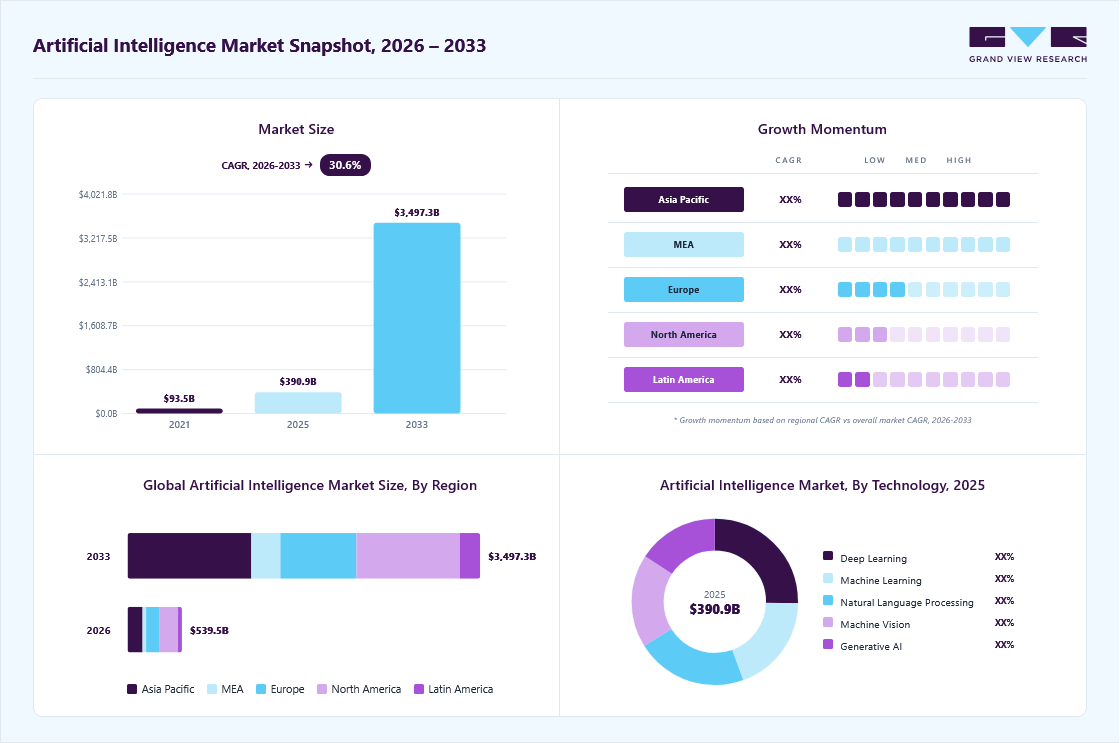
The global artificial intelligence market size was valued at USD 390.9 billion in 2025 and is projected to grow from USD 539.5 billion in 2026 to USD 3,497.3 billion by 2033, at a CAGR of 30.6% from 2026 to 2033. The North America held the largest share of 35.5% of the global market in 2025. The market is driven by the rapid enterprise adoption of generative and agentic AI, with massive investments and expanding real-world applications is accelerating AI’s transition from experimental use to core business infrastructure globally.
The artificial intelligence market is experiencing a strong shift toward generative and multimodal AI, significantly influencing adjacent domains such as the automotive artificial intelligence market and the artificial intelligence chip market. Enterprises are rapidly integrating these capabilities into core workflows such as content generation, customer support, software development, and design automation, with expanding use cases across the artificial intelligence in healthcare market, artificial intelligence in retail market, and artificial intelligence in supply chain market. This transition is supported by continuous improvements in large language models, diffusion models, and foundation model architectures that enhance accuracy and contextual understanding, further accelerating innovation in the artificial intelligence in manufacturing market and artificial intelligence in drug discovery market.
The fast growth of AI infrastructure and hardware improvements to meet rising computational needs, especially in the AI chip market is also driving the market. Edge AI is also becoming more popular, allowing real-time data processing on devices such as smartphones, IoT systems, and autonomous machines. This supports applications in supply chain and retail AI. At the same time, there is more attention on making AI models more energy-efficient and using sustainable computing, since large-scale AI uses a lot of power, especially in fields like healthcare and genomics. Cloud providers are also growing their AI-as-a-service options, so businesses can use advanced AI tools without big upfront costs. This is helping more industries, like drug discovery, adopt AI.